



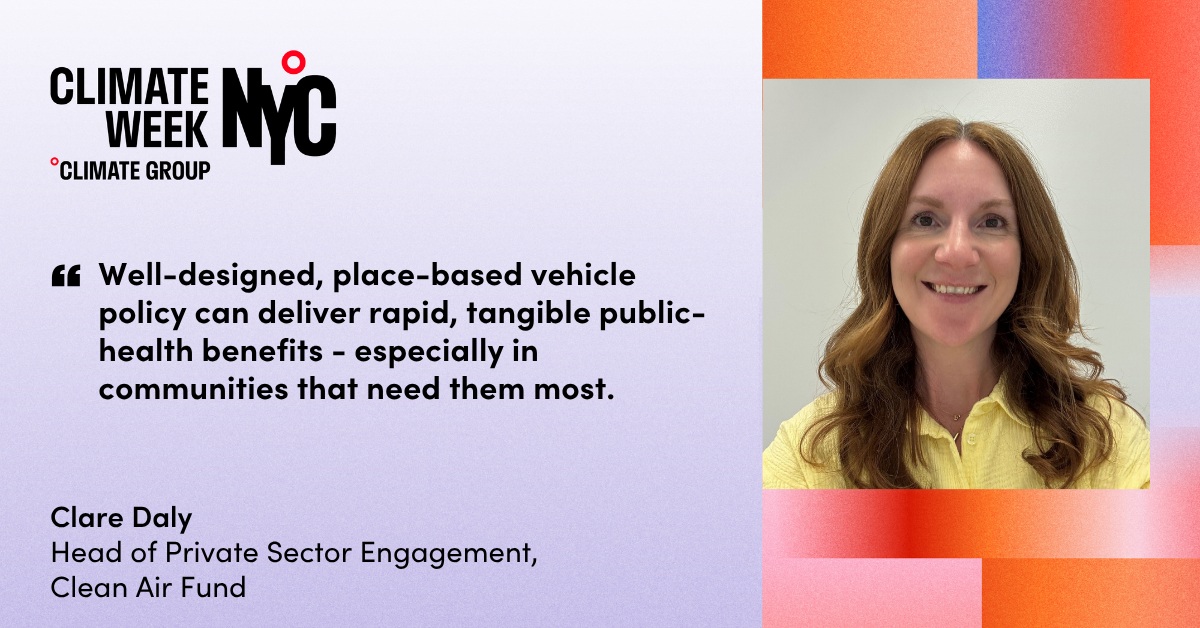
Clare Daly, Head of Private Sector Engagement, Clean Air Fund
The order you decarbonize in matters
A recent study from MIT found that two actions that cut the same ton of CO₂ can deliver significantly different benefits for people's health.
The researchers compared corporate actions like buying renewable electricity and cutting air travel. Air travel caused about three times more damage to air quality than comparable electricity purchases for the same level of climate damage.
As lead author Yuang Chen puts it, "if organizations want to achieve net zero emissions while promoting sustainability, which unit of CO₂ gets removed first really matters a lot."
Corporate sustainability leads could take this insight into 2027 planning. Net zero is the destination, but the route you take decides who breathes easier on the way.
Why location is the variable most companies ignore
CO₂ mixes globally, but the health-harming air pollutants emitted alongside it do not. This means that if carbon is a global ledger, air pollution is a local one. Action on clean air is climate action you can measure on the street where your workforce, customers, and communities live.
This is uncomfortable for a reporting culture built on a single CO2e number, but it's also an opportunity. Companies that ask where and who, not just how much, can find climate actions that pay a health dividend in the communities they operate in.
Fleets are where this gets tangible
Nowhere is the climate-health overlap clearer for companies than fleet vehicles. Clean Air Fund is a partner organization of Climate Group's EV100 initiative precisely because we see the huge potential for clean transportation to solve a public health crisis.
EV100 member BT's recent report with Ricardo covers the topic very well for the UK. BT and Openreach run over 27,000 vehicles, and the report shows that near-full fleet electrification could cut nitrogen oxides (NOx) emissions by 98% by 2050. BT puts the cost of slowing down the ZEV mandate at an additional £8.6 billion in health costs and 120,000 premature deaths at risk.
The place-based evidence is the real story
BT’s report references an exciting case study from Bradford in the UK, where a Class C Clean Air Zone launched in 2022 is charging the most polluting commercial vehicles.
What happened next is the kind of result climate teams rarely get to show: roadside NO₂ concentrations fell by around 11-12 μg/m³, and NHS data showed primary care visits for respiratory conditions dropped roughly 25% and cardiovascular visits 24%. That’s about 730 fewer doctor visits a month and over £450,000 in avoided health service costs a year.
Well-designed, place-based vehicle policy can deliver rapid, tangible public-health benefits – especially in communities that need them most.
What could this mean for the future of corporate sustainability?
Clean air is an easy way for companies to quantify their impact at the intersection of climate and health. This could pave the way for:
-
Air pollution reporting becoming as common as greenhouse gases. Smart Freight Centre’s Global Logistics Emissions Council framework already includes health harming air pollutants for companies who want to start on this journey.
-
Sequencing becoming a strategic choice. Expect leading companies to deliberately front-load the decarbonization actions with the highest local health payoff.
-
Cities becoming the unit of corporate climate action. Not because it's easier, but because that's where the benefits are visible to employees, customers and regulators at the same time.
This is why Clean Air Fund is partnering with Climate Week NYC this year, because clean air is a way to make climate action immediate, local and visible. To make this point, Executive Director of Breathe Cities, Cecilia Vaca Jones, joined a panel of business leaders who are grasping the health benefits of fleet electrification.
Decarbonization is a health intervention. Companies that treat it that way will get more credit – and deliver more good – than those that don't.