



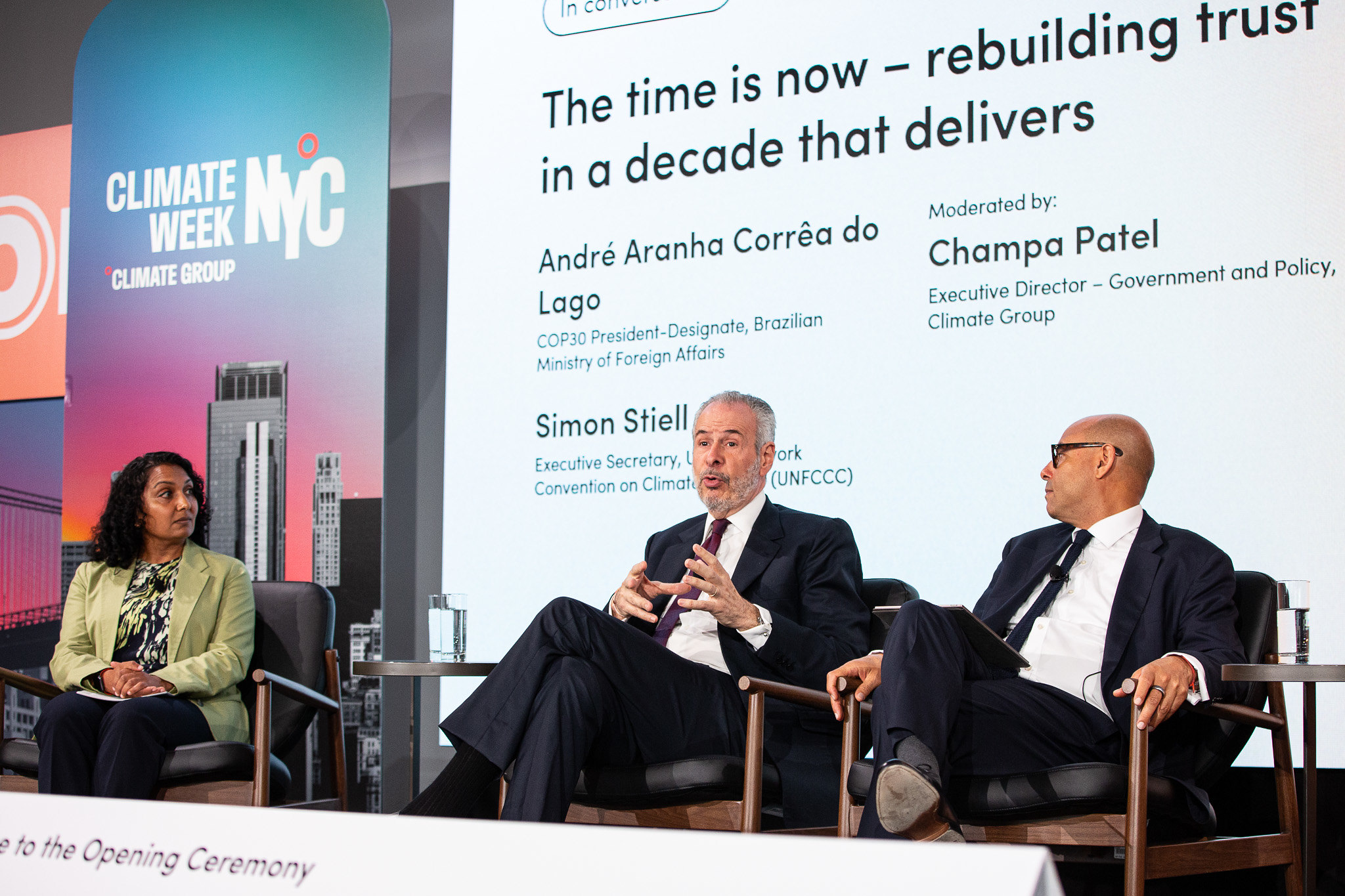
Climate Week NYC is around the corner so we sat down with Champa Patel, Executive Director of Governments and Policy, to discuss how financers can accelerate cuts to emissions, while making sure workers and communities share in the benefits:
Q1. What's the strongest argument you'd make to a finance minister who still sees climate action as a cost rather than a competitiveness issue?
"I'd tell them they're already paying the cost; they're just booking it under a different budget line. The cost of inaction is far greater than the cost of action, so it's a chance to stop paying for the same risk twice, once in carbon pollution, and then again in exposure and damages caused by wildfires, droughts, floods or extreme storms. According to the World Economic Forum, the global cost of climate change damage is estimated to be between US $1.7 to 3.1 trillion per year by 2050. Every finance minister currently managing fuel subsidies, disaster response budgets or energy price shocks is already paying heavily for their dependence on oil, gas and coal."
Q2. What is the role of business in freeing up money for climate solutions? And how can governments work better with them?
"Businesses bring capital, commercial expertise and a focus on risk. Governments bring long-term policy certainty, planning powers and public investment. Neither can deliver the transition alone, and neither works without the other. What's missing isn't willingness on either side. It's a shared pipeline: investable, de-risked projects that businesses can actually underwrite. Governments that show up with a pipeline rather than a wish list will attract the capital. But often governments don’t speak the language of investment, meaning to demonstrate the economic worth of a project, not just its social benefits. We’ll continue to drive greater collaboration between businesses and governments on this point at Climate Week NYC."
Q3. Whether it's cleaner transport, lower energy bills, flood resilience or green jobs – what are some of the tangible benefits communities see from climate investment?
"Climate investment rarely does just one job. Take London's Ultra Low Emission Zone: alongside the revenue it's generated for public spending, the scheme is linked to a 9.3% drop in the yearly trend for cardiovascular emergency admissions. That means fewer children in A&E, it means healthier families, less pollution related diseases. Scale that logic up and the pattern holds. Renewables generate roughly three times more jobs per dollar invested than fossil fuels. They don’t pollute our air, and you can’t fight wars over the sun. Climate investment improves people's daily lives through cleaner air, lower energy costs, more resilient infrastructure and better jobs. Those benefits aren't side effects – they're part of the economic return on investment."
Q4. What's the biggest misconception business and government leaders still have about the economics of the transition?
"That it's a national-level decision with a national-level price tag. It isn't. Subnational governments oversee, on average, 63% of climate-related public expenditure and 69% of climate-related public investment, according to the OECD. But they only see a fraction of the finance available to national governments. That's not simply a funding gap – it's a competitiveness gap. Leaders keep pricing the transition as if the national balance sheet is the only one that matters, while the states and regions that are actually responsible for building grids, permitting projects and setting procurement rules are unable to access capital at the scale required. It's also why the COP31 Presidency has made subnational delivery capacity a named priority on the road to Antalya, not a footnote."
Q5. FASTR aims to bridge the gap between climate ambition and investment. What problem is it trying to solve that existing finance mechanisms haven't?
"Most finance mechanisms are built for national governments or for individual projects. That’s caused a delivery gap. The Finance Accelerator for States Transition and Resilience, or FASTR, fills the missing middle between national climate finance and individual projects. States and regions are where infrastructure gets built, permits are issued and investment decisions become reality. Existing mechanisms haven't solved that because they weren't designed to. FASTR ensures that if you can de-risk at the level where implementation is happening, through subnational actors like states and regions, the capital will follow the delivery - not the other way round. This will enable capital to flow faster and at greater scale. FASTR is designed to make subnational governments investment-ready because the transition will ultimately succeed or fail where implementation happens."
For additional commentary and interview requests, please contact Tom Nice, tnice@climategroup.org.