



Climate Week NYC is halfway now, with hundreds of exciting events still happening across town in the coming days. From sessions on AI datacenters and political leaders meeting on Governors Island, to discussions around narratives and climate storytelling – New York City is buzzing with climate.
But here, we’re looking back on the past few days, and on Opening Ceremony and The Hub Live in particular. One sentiment seemed to emerge across those two days: the call for courage in the face of headwinds. Being loud. And treating the climate crisis as a security issue.
Opening Ceremony
You could sense it in the speeches of the Opening Ceremony. When Climate Group’s CEO Helen Clarkson OBE made a heartfelt plea to not be silent, as that cedes territory to peddlers of misinformation. Or The Hon. Prime Minister of Australia, Anthony Albanese MP, who lauded the work of so many first responders in his country, who step up in the face of adversary: ‘As leaders, we must match their bravery.’
And the UK’s Secretary of Foreign, Commonwealth and Development Affairs Ed Miliband MP emphasised that ‘climate breakdown must be an issue for foreign ministers and prime ministers, as well as energy and climate ministers. The generals, not just the green campaigners. […] Climate and nature must be embedded in national security systems, in threat assessments, and contingency planning.”
His remarks aligned with those of Lt Gen. Richard Nugee CB CVO CBE: “Climate change is not a threat that might happen. We know it will."
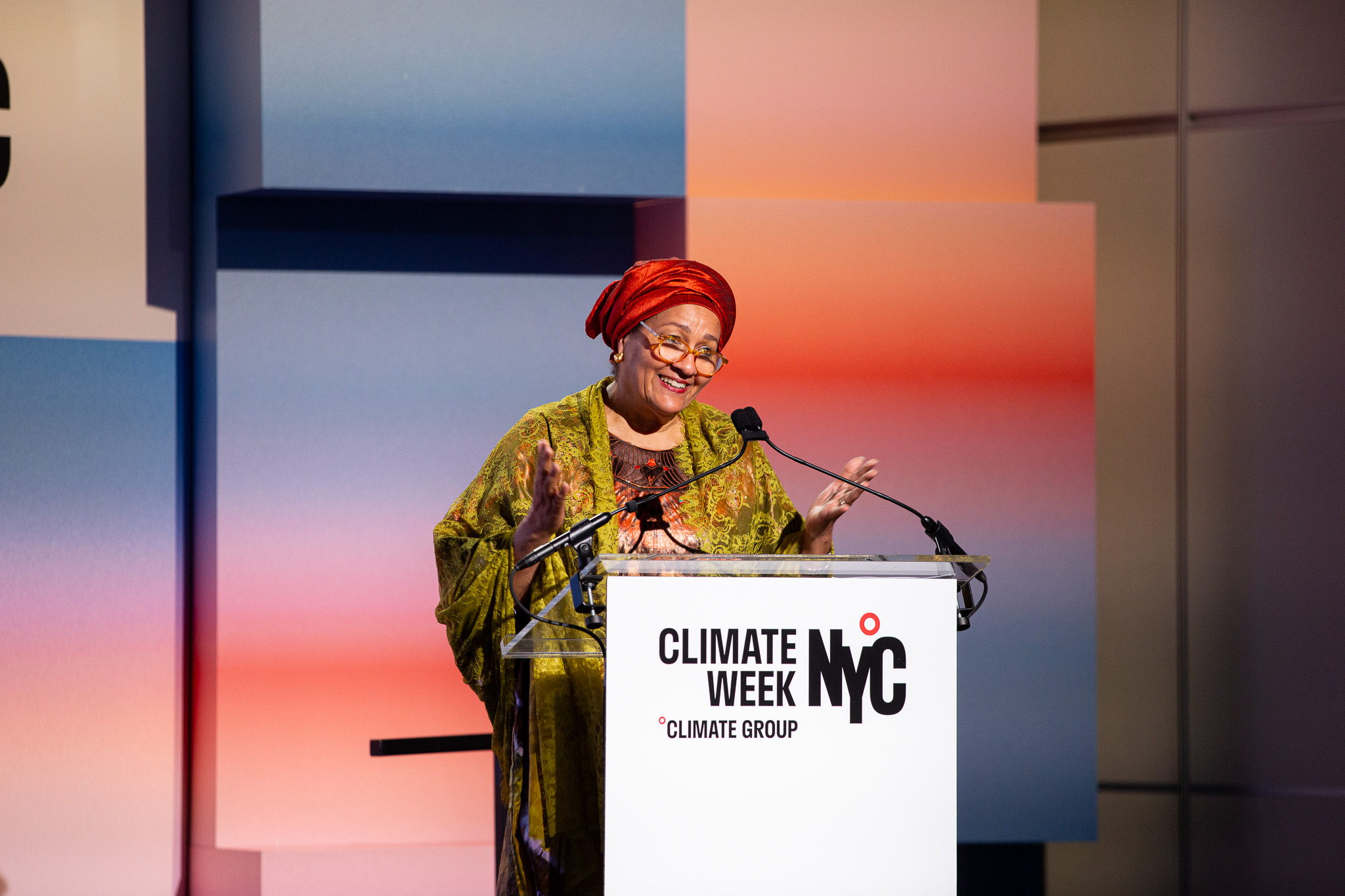
And H.E. Amina Mohammed, Deputy Secretary-General, United Nations, said: “We are breaching 1.5 degrees. But we are clawing back.” Later that morning, H.E. Emine Erdoğan, First Lady, Republic of Türkiye, urged the audience to treat waste as a priority, emphasising that COP31 will position curbing waste as a tool for climate action.
The morning ended with H.E. Kristrún Frostadóttir, Prime Minister of Iceland, urging countries and companies to plan ahead, and take action for the long term; “the transition will be won by whoever builds the capacity years ahead of needing it.”
That was exactly the take just one room away, where leaders from government and business met for a High-Level Dialogue on electrification, as part of the Global Renewables Summit. Speed up now, to electrify the future.
Mauro J Atalla, Senior Vice President and Chief Technology and Sustainability Officer, Trane Technologies, spoke in similar lines, about moving from pledges to performance.
Buildings account for a large share of both emissions and energy use, he said, and a significant portion of that energy is simply wasted. Paid for, but never used. The controls and the data to fix that already exist. What's missing, he said, is everything around the technology: stable policy, standards that measure the benefits, and pricing signals from cities and governments. "This is not a technological barrier. The technology is already there."
And of course AI, and the data centers that facilitate it, was a hot topic in many conversations. If not directly then looming in the background, as it’s poised to play a major role in the shape of our future.
Dr. Eva Riesenhuber, Global Head of Sustainability, Siemens, argued that AI is already doing useful work inside buildings, automating shading and cooling, and that the bigger prize is turning buildings into nodes on the grid, moving power in both directions. On data centers, she pointed to a future of waste heat being piped into district heating systems to warm nearby homes. "We believe that future data centers can be carbon and water neutral."
And also:
- Nigeria launched a US $300 million clean energy fund to expand access to off-grid power.
- Türkiye's COP31 delegation announced a new global initiative on how AI can support climate progress
- Climate Group's EV100 announced a partnership with Smart Freight Centre to accelerate freight decarbonization globally, starting in Mexico and South Africa.
The Hub Live
The Hub live kicked off in Monday with a topic that is top of the agenda from cabinet tables to kitchen tables: the ongoing energy crisis. Damilola Ogunbiyi, CEO and Special Representative of the UN Secretary-General for Sustainable Energy for All was solutions focused in her approach. The first thing you do in a crisis, she argued, is use less: efficiency could cut consumption by a quarter to even a third, alongside a faster rollout of renewables.
In a similar vein, Scott Tew, Global Head of Sustainability Strategy, Trane Technologies, was clear about the approach needed to overcome the energy demand and extreme heat issues facing us down. Tew's argument was that our collective response is still built for one bad day, rather than for a changed climate. "We're still using band-aids. This is no longer acute."
Eriel Deranger, Founder and Executive Director, Indigenous Climate Action, and Mithika Mwenda, Pan African Climate Justice Alliance, joined Helen Clarkson, for the final Flagship session of day one, on how climate and community can better connect. "Our communities don't need to be saved. We have so many of the solutions. They just need investment," urged Deranger.
Dr Fatih Birol, Executive Director of the International Energy Agency (IEA), used his opening keynote speech on Day 2 in The Hub Live to explore how energy security, economic competitiveness and climate objectives are converging, with “trust” central to energy policy for governments around the world. He laid out four trends shaping the energy system: the continued rise of solar and electric cars, the persistence of coal, renewed interest in nuclear, and how countries have responded to the energy crisis. Diesel prices, he noted, are at historic highs in many countries.
With many of the speakers at The Hub Live looking ahead, the urgency never left the room. Perhaps that was best captured by Dr. Maina Vakafua Talia, Minister for Home Affairs, Climate Change and Environment of Tuvalu. He said he would speak from the heart, and did.
"Who shall we blame if we wake up the next morning and half the population is gone? This is about survival. For us it's a matter of life and death."
Johanna Jobin, Global Head of Environmental Sustainability and Compliance at Takeda, said healthcare goes far beyond hospital walls. Takeda is targeting net zero across its value chain by 2040, and the hardest part is exactly there, where cost-effective solutions don't yet exist and a heavily regulated industry limits what can be substituted. Her ask of the room was direct:
"Less convening and more action."
If you want to read back about everything that was said on stage – visit our Highlights section, where you’re find the liveblogs and a full overview of all announcements
Stepping off stage
But now it’s time to step off stage because as always, discussion and announcements were not confined to The Hub Live the plenaries and breakouts alone: California Attorney General Rob Bonta held a press conference announcing new legal action, suing the Trump Administration and offshore wind developer Invenergy over a federal agreement to terminate Invenergy’s California offshore wind lease. The lawsuit challenges the reported US $111 million federal buyout that would pay Invenergy to abandon its Morro Bay offshore wind lease.
And the Lagos state government announced a US $25–50 billion climate investment pipeline. It says its pipeline has more than 300 investment-ready projects across clean energy, resilient infrastructure, water and the circular economy, and with plans to take them to investors at COP31 in Antalya.
Because Climate Week NYC doesn't stop in New York. The conversations here will continue all the way to COP31 in Türkiye, and that was palpable this year we hosted work by the Turkish painter and tapestry weaver İlhami Atalay, on display in the venue. Alongside this, Garip Ay was painting live, linked up to the big screen. He works in ebru, the traditional Turkish art of marbling, where pigment is floated on water and then lifted onto paper.
And a bit further afield, across town on Wednesday, Gavin Newsom, Governor for the State of California, spoke with Champa Patel, Executive Director for Governments and Policy at Climate Group. Under2 founding member California announced its Cap-and-Invest partnership with Washington. Building on its partnership with Quebec, California is expanding regional collaboration to cut emissions and accelerate the clean economy. Governor Newsom said, “it’s all about people”. The initiative has supported 143,000 jobs and delivered $16 billion in utility bill credits.
And against a backdrop of rising climate impacts, geopolitical uncertainty and shifting national priorities, the inaugural Governors Dialogue on Governors Island, in partnership with The New York Climate Exchange, brought subnational leaders together to focus on delivery and delivering the tangible benefits of climate action: jobs, lower energy and food bills, cooler buildings and cleaner transport.
The Subnational Methane Action Coalition hosted a tour of the Newton Creek Wastewater Treatment Plant with member governments, to see the circular economy in action. A pilot partnership was announced between UC Berkeley CLEE and the Maryland Department of the Environment to strengthen methane action through new advanced planning and emissions-analysis tools.