



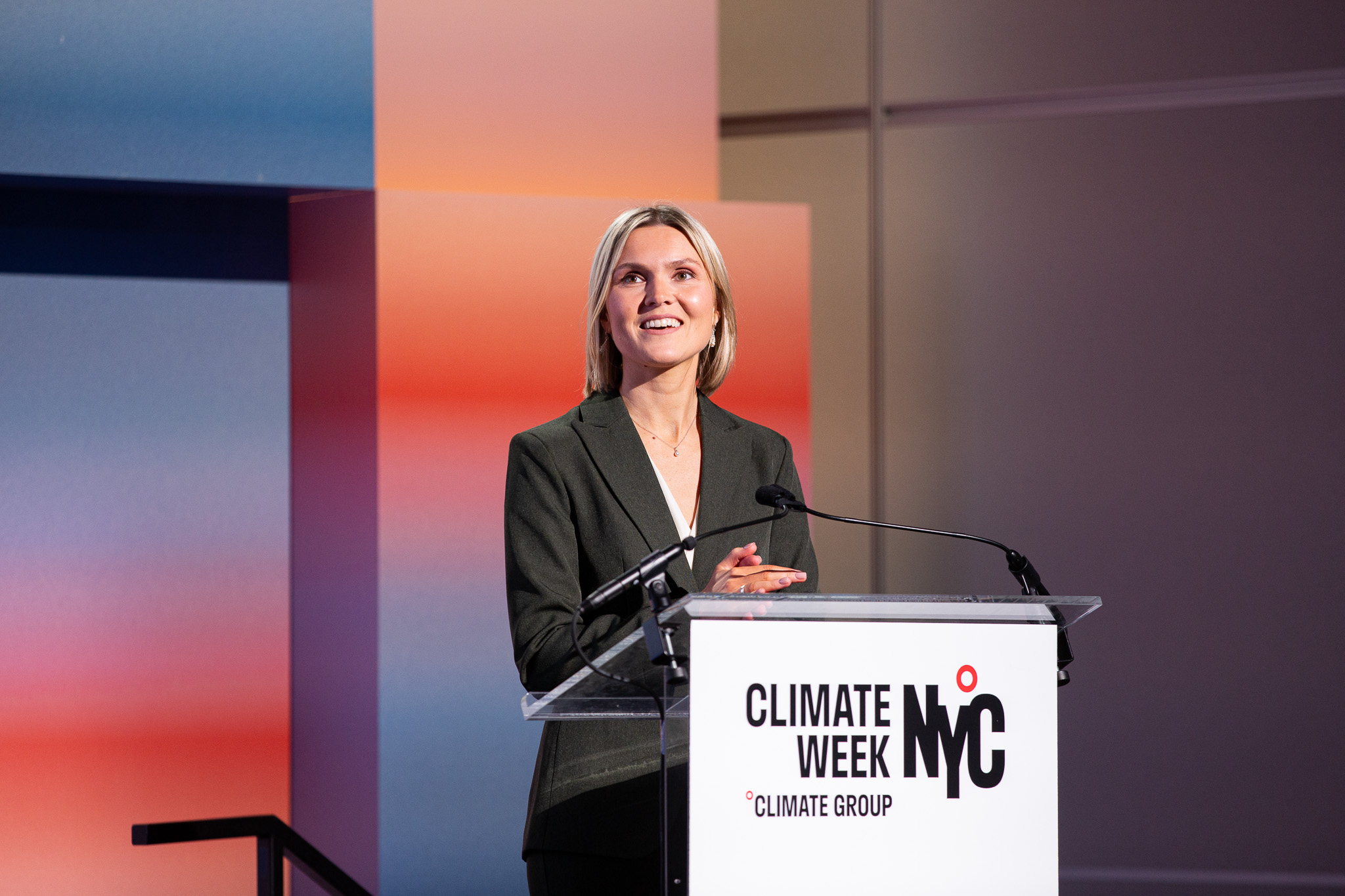
Prime Minister of Iceland H.E. Kristrún Frostadóttir gave this year’s closing keynote speech of Climate Week NYC, focused on energy resilience and geothermal power.
Dear guests, colleagues, fellow leaders,
It’s a great honour to close today’s Opening Ceremony at Climate Week, and I think it’s a fitting place to land. Because everything we’ve heard today keeps circling back to the same question: not whether this transition is possible — we all know it is — but how fast we can build the resilience to carry it through in an increasingly uncertain world.
In an effort to answer the question, I’d like to tell you a story. Iceland’s story. Because I think it holds a lesson that goes well beyond energy.
This is a story that began with a crisis.
But Iceland’s relationship with geothermal is much older than any energy crisis, of course. People had been bathing in it since the days of settlement, more than a thousand years ago. By the early twentieth century, the first pipes were already carrying hot water into homes and greenhouses in Reykjavík, and by the late 1960s a small plant at Bjarnarflag had shown that the same heat could make electricity as well.
But let’s be honest: it was geothermal at the margins. One town, one greenhouse, one experiment at a time.
Back then, in the early 1970s, most Icelandic homes were still burning imported oil for heat. Enter the oil crisis. Prices exploded. Household budgets were hit. And a small island nation, far from every market and every supplier, learned the hard way what it means to depend on something you can’t control.
So, we made a choice. Instead of riding out the volatility, we turned to what was right under our feet. Reykjavík built a large-scale geothermal district heating system in a matter of years. Other towns followed, with many finishing the switch within a single decade. It took unwavering political will, financial support mechanisms that helped ordinary households make the switch without ruinous upfront costs, and — perhaps rarest of all — a cross-party consensus that outlasted several governments.
Obviously, it wasn't political will alone that drove this. It was also technology — better drilling techniques, better pipes, better ways to move hot water long distances without losing heat or water along the way — and a fast-growing body of Icelandic geothermal know-how, learned largely through trial and error, well by well. Engineering caught up with national ambition.
Today, virtually every home in Iceland is heated with renewable energy — more than ninety percent of it geothermal. Geothermal also contributes to our, almost 100%, renewable power grid. We import next to no fossil fuel for heat. And a resource that was once a matter of survival has become one of the great equalisers in our society: a family in a small fishing village and one in the capital region should in general pay the same to stay warm through an Arctic winter.
This is the first lesson: Resilience wasn’t built while the crisis was happening. It was built in the years after — deliberately, patiently, as a national mission — so that the next shock wouldn’t hit as hard, if at all.
Now, why are we still at it in Iceland?
We’re not treating this geothermal energy transition as finished business. This year, my government launched what we call “Geothermal Levels the Playing Field” — a new push to bring geothermal heating to the remaining parts of the country that haven’t had the chance to benefit from it yet, so this equaliser reaches every region, not just the areas where the geology is easy.
This project is not about rationing what we already have. By continuously developing know-how on the geothermal resource, we’re actually expanding it: building more, faster, for more people and a growing economy.
Simultaneously, we’re reaching for the next frontier. Beneath Iceland lie zones where the rock itself starts to melt — superhot geothermal, where a single well can outperform many conventional ones, many times over. Our flagship effort is IDDP-3, a superhot well that we’re drilling next year at Hengill. This has been twenty-five years in the making, and is the product of a unique body of Icelandic engineering knowledge, which has been accumulated well by well, decade by decade – knowledge very few nations on earth possess.
IDDP-3 is relevant to you all because it is an export of ingenuity as much as a well in the ground: Icelandic know-how can put superhot power within reach of others, it’s not just made for us. Further north in Iceland, at Krafla, we’re also laying the early groundwork for longer-horizon research into the hottest zones science has yet to reach — patient work, still years from results, but work that keeps Iceland at the frontier of what’s possible in geothermal.
This is mission driven government — with the same type of conviction that once sent people from other countries to the moon. But in our case it’s aimed at the depths of the earth, and is being put to work in the service of the wider world.
So what is the lesson beyond Iceland?
I’m not telling you this, so you’ll admire us. But because I think our experience is relevant for every leader in this room, whatever sector you come from.
The transition each of you is managing — in energy, in supply chains, in infrastructure, in economic competitiveness — won’t be won by the country or the company that reacts fastest to the next disruption. It’ll be won by the one that has already built the capacity to absorb it, years before it arrives. Resilience, in other words, isn’t a response. It’s a foundation you pour long before anyone tells you the storm is coming.
It takes four things we found essential in Iceland’s story. Sustained political will that survives electoral cycles. Patient capital that’s willing to fund the drilling, the research, the decade before the payoff. Public trust, earned by ensuring the benefits of the transition are shared, not concentrated. And a state that understands that permits and processes need to be continuously optimized – instead of treating them as monuments to be defended. A state, a government, a public system that measures its success by what actually gets built properly, not by what gets blocked.
So look at this as an open invitation.
Iceland can’t do this alone, and we don’t want to. A century of learning by doing — by our engineers, our geologists, our drillers — has given us a body of ingenuity that very few countries possess. That’s Iceland’s real export in this field: not just the heat beneath our feet, but the knowledge of how to reach it, safely and at scale. We’re not monopolizing this know-how. We’re putting it on the table.
To the utilities and energy companies here wrestling with baseload and price volatility: our reservoir of geothermal engineering experience is available to you. To the governments here designing your own heating and cooling strategies: Iceland stands ready as a partner, and as a testbed, for solutions you can take home and adapt to your own geology and your own grids.
Europe’s forthcoming Geothermal Action Plan is a real opportunity, and we intend to be closely involved in shaping it. And to every innovator here looking for the next frontier in clean baseload power: come drill with us. Come test with us. Let’s build the coalition this technology deserves.
In closing, the direction of travel, as today’s theme reminds us, is already set. The only real question left for leaders — for all of us in this room — is what it takes to keep moving forward, faster than the disruptions yet to hit us.
Our answer, from a small island in the North Atlantic, is this: start before you must. Build the resilience before the crisis tests it. Choose, deliberately, to build — more supply, more capacity, more of the things that will carry you through — rather than managing the scarcity of what you already have. And when you find the thing beneath your feet that can carry you through the next fifty years, don’t wait for permission. Turn it into a national mission and see it through.
Thank you.