



Policy is imperative in accelerating and supporting climate action.
Policy levers form the framework to influence businesses, states, and individuals to act on climate and accelerate the transition to net zero. From EV tax credits to national manufacturing laws, the Policy program considers policy at all levels – local, state, international.
Here are some resources to learn more:
Read
This article from Cotality explores the mounting pressures facing Florida as it grapples with rapid population growth, escalating living costs, intensifying hurricanes, and overburdened infrastructure. These converging challenges are reshaping the state's future and raising urgent questions about sustainability, resilience, and long-term livability.
Gen Z's future may be costly despite cheap homes
Gen Z is stepping into homeownership at a time when affordability masks growing environmental and financial risks.
Texas could stress test property insurance
The ongoing U.S. insurance crisis was never a question of if; it was a matter of when.
A perfect storm of environmental risk, migration patterns, and complex regulations has made coverage either unaffordable or unavailable for millions of homeowners. Now, states like Texas face the same fate as Florida and California, where insurance is either wildly unaffordable or unavailable — or both. The crisis has arrived. The question is who gets left without a safety net.
Building codes save money, lives, homes; aid in climate resilience
Florida is the poster child for why building codes can greatly increase community resilience, help retain home values, reduce insurance costs, and decrease mortgage delinquency risks.
As a state, Florida has seen some of the largest in-migration in recent years. It has also seen the effects of climate change. According to research using Cotality's Climate Risk Analytics, the Sunshine State has the highest percentage of census tracts with high- to extreme-risk in terms of exposure to natural perils, which include wildfires, floods, hurricanes, and storms.
We're pleased to welcome Cotality as the Policy Program Partner for Climate Week NYC 2025
Read
An interview with Climate Group’s Head of Policy and Advocacy, Andrew Forth
Why does Climate Week NYC matter for policy makers?
2025, is a critical year for climate policy. COP30 needs to deliver a finance solution that funds a just transition for developing regions and scales up climate action. The cost of inaction is undeniably clear. The impacts of climate change are all around us – wildfires, scorching heatwaves and extreme flooding - and it’s sparing no one.
While climate naysayers wrestle with finding new ways to spread doubts about the science and do their best to delay the transition away from fossil fuels, the reality on the ground is that progress continues in spite of what is a challenging political climate and media narrative.
Globally, we’re seeing enormous investments in the green transition – some of it driven by a belief that it is the right thing to do, others by hardheaded capitalism. In fact, renewables and electric vehicles have proved so successful, outperforming fossil fuel alternatives and prompting desperate attempts to delay their adoption.
Climate Week NYC is an opportunity to send the message that delaying the transition isn’t just bad for the planet, it’s causing real harm to people and the economy.
What are the trends that we’re seeing?
We’re facing unprecedented policy uncertainty. And this isn’t just about the on again off again tariffs rattling financial markets. Under the radar, new global alliances are speeding up the uptake of renewables and the business case for the transition has never been stronger. Climate Week is an opportunity to meet the people powering and enabling these developments and dig deeper into what is going on beyond the headlines and soundbites.
AI is dominating the agenda, everywhere. It’s a double-edged sword offering huge potential to change how we tackle climate change while presenting new and major challenges for the energy system. Whatever your take on the value of AI, the rising energy demand is going to require and drive significant investment. The good news? Clean energy is the fastest and cost-effective way to meet that demand.
If you want to generate more electricity, then the quickest and cheapest way to do it is with renewables and storage. Over 80% of new capacity last year was renewable or storage based, with figures in Texas rising to 90%.
And then there is methane, a key driver of global warming – once overlooked and now gaining rapid attention. While methane dissipates more rapidly than carbon dioxide, it traps 80 times more heat.
As a result, it is methane that is driving nearly half of the warming we are experiencing – and emissions are rising fast. More than perhaps any other climate challenge, tackling methane emissions comes down to policy. Waste processing, innovations in agriculture and holding fossil fuel companies to account are all part of the solution.
Join us and see how leaders are working to address this vitally important issue and the benefits it is bringing to their communities and industries.
What role does Climate Week NYC play in the run up to COP30
Climate Week NYC is not only the largest gathering of business voices on climate action but a decisive moment for global policymakers to convene with other nations, foster a deeper collaboration and alignment on climate policies. The week-long event is a fertile ground for those seeking to influence policy at all levels of government.
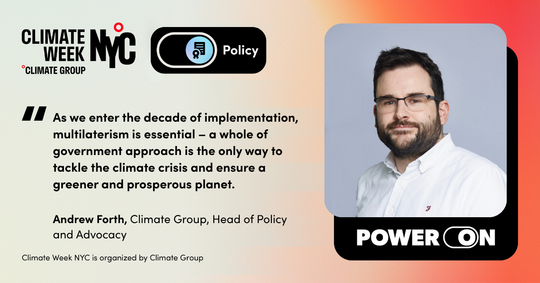
As we enter the decade of implementation, multilaterism is essential – a whole of government approach is the only way to tackle the climate crisis and ensure a greener and prosperous planet.
For businesses, it presents an opportunity for in-depth peer to peer knowledge sharing, closer collaboration with states and regional governments and a platform to take bold action by investing in the transition and keeping the Paris Agreement alive.
Climate Week NYC is the boardroom where global climate discourse is shaped, leading the road to COP30 and beyond Belem – it builds a sturdy bridge from national climate plans to implementation.
Both are critical moments that must complement each other sending a clear message that business and political leaders are determined to take action- even in the face of significant headwinds.