



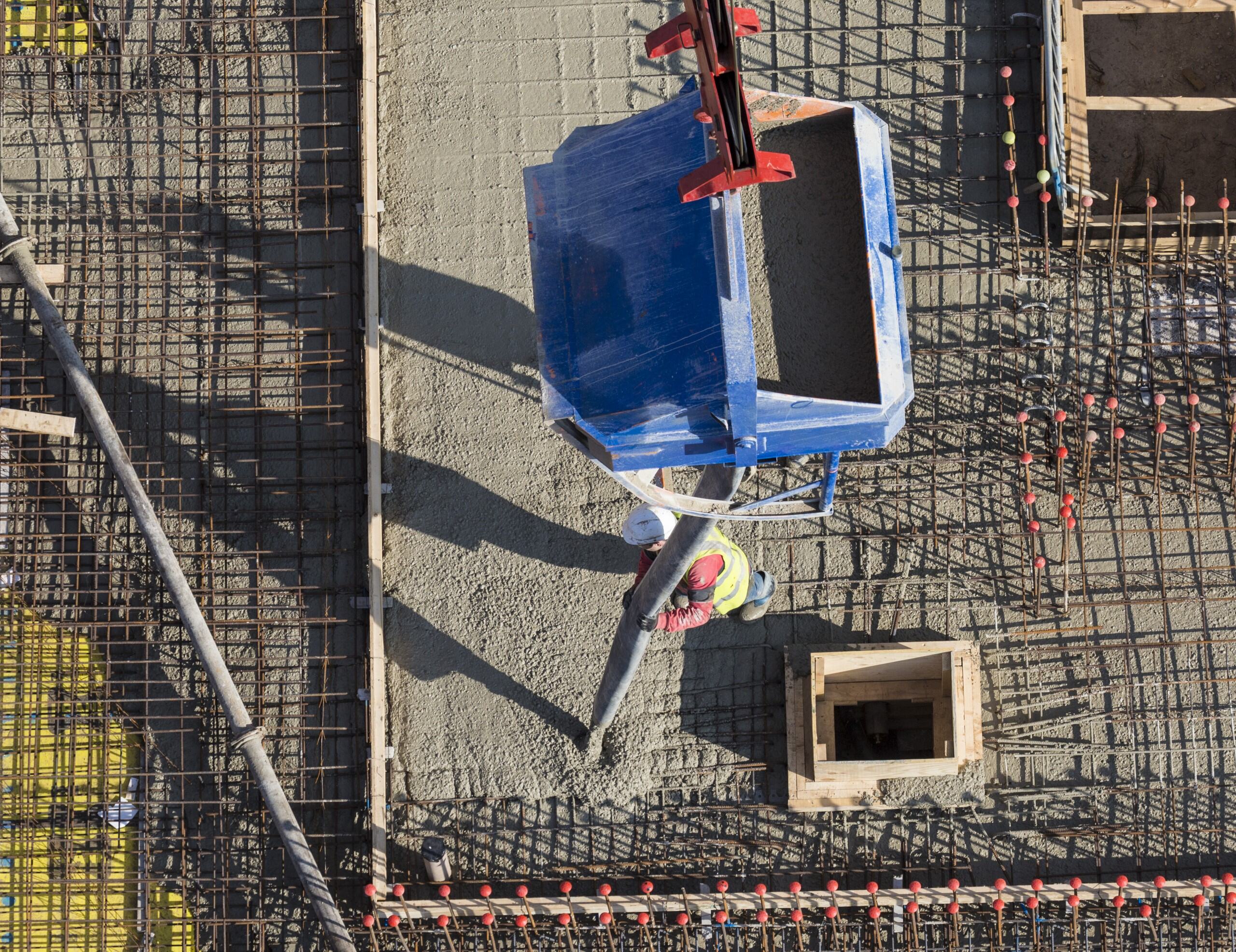
Climate Week NYC brings together visionaries and leaders that are working on the latest innovations, to speed up climate action. And sometimes, these innovations have already been tried and tested.
Take concrete and steel. We rely on industry for almost everything around us, from the buildings we live and work in, to the infrastructure that connects us. But as we grow the industries that make this possible, the question is no longer simply how much we need to make, but how we make it. We spoke to Wouter Vink, Director of Heavy Industry Transition at Systemiq, about the future of cleaner industries and supply chains, a key theme at this year’s Climate Week NYC (September 20–27), and the opportunities to make concrete lower-carbon.
We all rely on industry and construction in our everyday lives. What can have the biggest impact for the climate: changing how we use things, or changing how we make them?
It depends on the context: in some parts of the world, we've already built a lot, so there's a big opportunity to reuse, repurpose and recycle what we've already got. I mostly buy second-hand clothes and furniture, use car sharing, and live in a 125-year-old house., for example.
But we also know that we'll need to build a lot more. We roughly need to double the amount of floor space in the world by 2050 to meet a growing population and economic needs. So, for the things that inevitably need to be built, we've had to focus on how we make them.
You work on cement and concrete decarbonisation – the world’s most used material after to water and very carbon intensive to produce - therefore contributing significantly to global pollution. Before we get into solutions, can you help us understand what clinker is, and why it matters when we talk about reducing concrete's emissions?
Clinker is the glue that holds concrete together, and clinker is currently the dominant glue. The problem is that making clinker is where a large part of cement's climate impact comes from. To produce it, you heat the material to around 1400 degrees, which requires a huge amount of energy. But it's not just the energy involved. When the material is heated, it also goes through a chemical reaction that produces CO2. By using alternative "glues", we can avoid that pollution while still producing concrete that is safe, reliable and performs as needed.
So what could a cleaner future for concrete look like, and how close are we to it?
The future of concrete can start today.
One of the biggest opportunities is blended cement, which is essentially about combining different materials to make cement. It's a bit like wine: sometimes you blend different wines to create something better. The Romans were blending cement centuries ago. But at some point, we discovered clinker and fell in love with it because of how good it is at making cement – even though it comes with a significant climate impact.
The opportunity now is to use less clinker by blending cement with other materials that function as "glues", without compromising on strength, performance and cost. Blended cement is cost-effective, scalable, and produces similar performance to standard clinker cement.
The terms ‘low-carbon’ and ‘competitiveness’ are often presented as opposites. Can they go hand in hand?
Absolutely. We already see this with electric vehicles and solar power. These technologies are low-carbon, but they're also cost-competitive and offer a better product or experience.
For technologies that are not there yet, we need to make sure they become cost-competitive, available and attractive to users. Once those three things come together, the market can be an incredibly powerful force. There's also a longer-term competitive argument. As the climate costs of different technologies become increasingly clear, acting early can give companies an advantage.
So what’s stopping companies from moving faster?
It all depends on where the technology currently is at. If the conditions are right, there's actually a risk in not moving. Forward-thinking companies that embrace new climate innovations have a unique opportunity to lead the market and capture long-term growth.
When a cleaner option is still more expensive, public procurement is one of the solutions. If governments start buying blended cement for public infrastructure, they help to create demand, build confidence, and give companies certainty to scale up investments in cleaner production.
In your experience, what helps in convincing decision makers on adopting cleaner technologies faster?
Ultimately, one of the most convincing things is seeing the solution in the real world. We once brought people together to look at a building made using calcined clay, a type of low-carbon cement. Some of them thought the technology was still something being tested in a lab, but when they stood inside a real building made with it – seeing it, touching it and speaking to the contractor – it changed the conversation.
New solutions become business as usual not by asking people to take a leap of faith, but by showing them that the solution is already here, that it works and that it can meet their needs.
If you were standing on a construction site 10 years from now, what would you like to see?
The things we build as humanity are absolutely astonishing. And if you give an engineer a challenge or new constraint, those solutions will happen. Carbon dioxide is, to some degree, just another constraint.
What I would hope to see is people being proud to work in an industry that is taking proactive climate action and using more climate-positive and nature-positive materials, tools and technologies.
I would also love to see a more gender-diverse workforce in heavy industry and on construction sites. We need to see a much larger representation of women in careers related to industry.
Explore events across the theme of Industry and Supply Chains on our events calendar.