



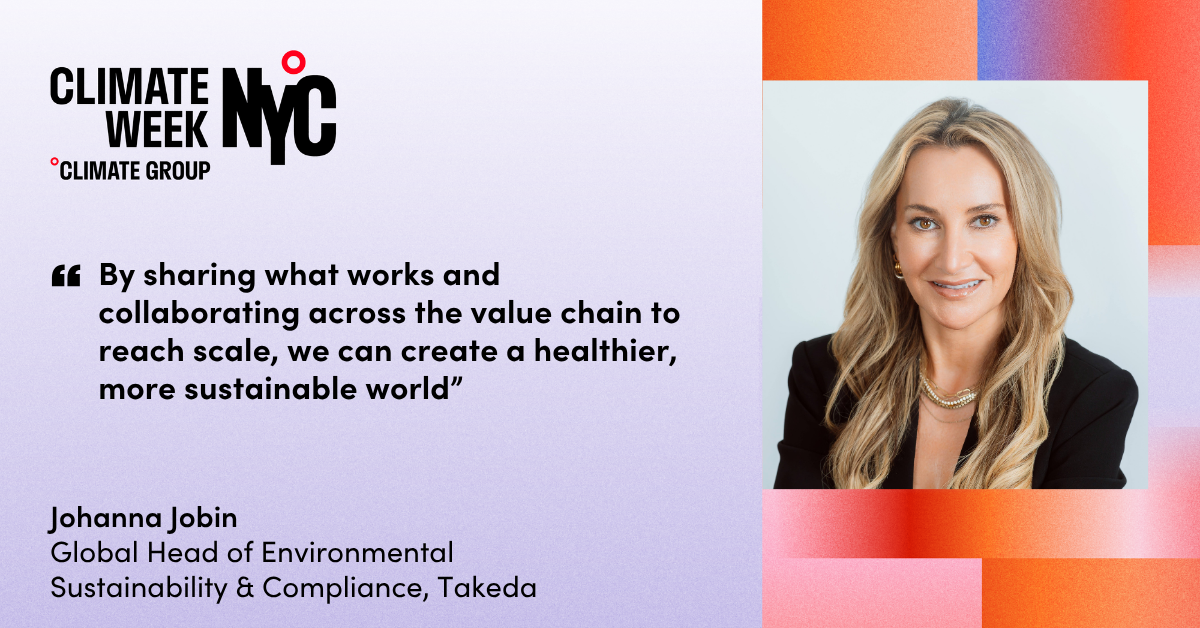
With Johanna Jobin, Global Head of Environmental Sustainability & Compliance, Takeda.
Climate change is a human health crisis. Flooding, air pollution and other environmental risks can increase the need for care while disrupting the systems that deliver it. By 2050, healthcare systems are expected to face an additional $1 trillion+ burden from climate-related costs, according to the World Economic Forum. It’s an issue that impacts everyone.
To understand how the pharmaceutical sector is approaching this challenge, we connected with Johanna Jobin, Global Head of Environmental Sustainability & Compliance at Takeda.
Climate Group: How does the connection between climate change and human health shape Takeda’s approach to environmental sustainability?
Jobin: For Takeda, we recognize health for patients extends beyond our therapies. The effects of climate change on human health reinforce the importance of reducing our environmental impact. Taking action can help support patients and communities while strengthening the resilience of our operations.
Takeda’s purpose, to create better health for people and a brighter future for the world, shapes our approach to environmental sustainability. As a values-based company with more than 245 years of history, our principles continue to guide how we work to reduce emissions throughout the development, manufacturing and delivery of our therapies while improving efficiency and creating long term business value.
We have some of the most ambitious climate targets in the industry. Takeda is committed to achieving net-zero greenhouse gas emissions across our operations by fiscal year 2035 and across our value chain by fiscal year 2040. As of FY2025, we’re making progress and have reduced emissions from our operations 58% since FY2016, and Scope 3 emissions 10% since FY2022.
Climate Group: For most companies, the majority of emissions sit within the value chain. Can you give an example of ways that Takeda is innovating to address Scope 3 emissions?
Jobin: One example is our work with Boston Medical Center (BMC) to reduce Scope 3 emissions associated with medical waste and pharmaceutical packaging. These emissions can be particularly tricky to address because they span the healthcare value chain—from how products are designed and packaged to how they are used and disposed of. That means we need to work across the ecosystem, up and down the value chain, to identify and test solutions.
That’s why Takeda partnered with BMC, bringing together BMC’s clinical and operational expertise with Takeda’s expertise in environmental health, safety and sustainability, pharmaceutical and packaging expertise. In the first year, audits found that 75–85% of regulated medical waste reviewed was incorrectly sorted. Improving sorting alone could reduce related disposal emissions by nearly 70% while also lowering costs.
Those findings are already informing staff education and standardized bins and signage, while also helping identify opportunities to rethink pharmaceutical packaging. BMC has published the findings along with a “how-to” guide so other healthcare institutions can conduct similar assessments.
Now, Takeda and BMC are using the data to develop and pilot solutions, with the goal of creating approaches that can be replicated and scaled across the broader healthcare ecosystem.
Climate Group: While mitigation is critical, we’re also seeing an increased focus on adaptation. How does Takeda address the issue?
Jobin: Innovative approaches to decarbonization can strengthen resilience. For example, Takeda is set to become the first biopharmaceutical company to ship medicines aboard VELA’s first-of-its-kind wind powered cargo trimaran. This is expected to reduce emissions by 99% compared with air freight and up to 90% compared with conventional container shipping. We’re also shiftingmore transportation from air to sea, which, in one instance, reduced emissions by 980 metric tons and costs by 65% on a route between Europe and China.
Beyond our operations, our Global CSR Program recently committed $22.2 million to four organizations working to advance climate-resilient health systems around the world, including early warning and continuity of care in Nepal, and pharmacist training to prepare for and respond to climate-related health needs in Ghana. These locally led efforts help communities maintain access to care as climate risks grow.
Climate Group: Despite the scale of the challenge, what gives you hope for the future?
Jobin: Understandably, there is considerable focus on the negative tipping points the world is approaching, yet the actions we take today can have a meaningful long-term impact. A recent study from the University of Exeter and The Earthshot Prize found that targeted interventions can push environmental solutions past “positive tipping points.” The report claims that once new approaches become sufficiently affordable, accessible and attractive, the momentum becomes increasingly self sustaining.
In our own way, Takeda is collaborating across the healthcare ecosystem to create positive tipping points. I’m optimistic that by sharing what works and collaborating across the value chain to reach scale, we can create a healthier, more sustainable world.
Learn more about Takeda’s environmental sustainability and progress.